


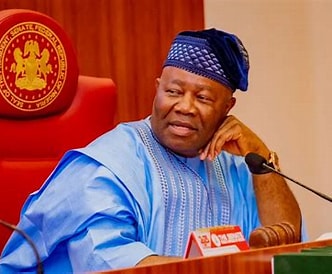
Senate President Godswill Akpabio has pushed back against criticism surrounding the National Assembly’s ongoing amendment of the Electoral Act, insisting that the Senate has not removed provisions for electronic transmission of election results as widely alleged.
Akpabio made the clarification in Abuja while speaking as Special Guest of Honour at the unveiling of a book titled The Burden of Legislators in Nigeria, authored by Senator Effiong Bob. His remarks come amid growing public debate and concern from legal bodies, civil society groups, and opposition parties over reports that the Senate rejected mandatory real-time electronic transmission of election results.
According to a statement made available to Sunday PUNCH, the Senate President said critics were misjudging lawmakers based on an incomplete legislative process and misunderstanding the stage of deliberations.
“The Electoral Act amendment is incomplete. We have not concluded work on it, yet people are already on television debating what is not yet law. They don’t understand lawmaking,” Akpabio said.
Akpabio explained that the controversy stemmed from the Senate’s consideration of whether to retain the phrase “real-time” in the law regarding the electronic transmission of election results. He stressed that lawmakers did not vote to eliminate electronic transmission but only questioned the practicality and legal implications of mandating real-time transmission across the country.
“I must state clearly, without ambiguity, that the Senate has not removed any means of transmission. If you want to use a bicycle to carry your votes from one polling unit to the ward centre, do so. If you want to use your phone, your iPad, or any electronic device to transmit, do so,” he said.
The former Akwa Ibom governor argued that including the phrase “real-time” could create legal vulnerabilities during election litigation if network failures, insecurity, or infrastructure breakdowns prevented immediate transmission.
“All we said was that we should remove the word ‘real time,’ because if there is a grid failure or poor network and you go to court, someone will argue that the law required real-time transmission. That could invalidate results,” he explained.
Akpabio highlighted Nigeria’s infrastructural challenges, especially in areas affected by insecurity and poor telecommunications coverage. He warned that insisting on real-time transmission nationwide might disenfranchise voters in regions where network access is unreliable.
“In over nine states where networks are disrupted because of insecurity, there may be no election results if we insist on real time. If the national grid collapses on election day and networks fail, does that mean the entire election becomes invalid?” he queried.
He maintained that the Independent National Electoral Commission (INEC) should retain the discretion to determine the most appropriate method and timing of transmitting election results within the legal framework provided by the Act.
The Nigerian Bar Association (NBA) had earlier criticized the Senate’s position, urging lawmakers to explicitly include mandatory electronic transmission of results in the amended Act. In a statement posted on X (formerly Twitter), the NBA warned that retaining the existing wording—allowing results to be transmitted “in a manner prescribed by the Commission”—could weaken transparency and create room for ambiguity and manipulation.
Responding indirectly to such criticisms, Akpabio accused some commentators and civil society actors of attempting to impose their views on the legislature without fully understanding parliamentary procedures.
“People have become mouth legislators. If you want to make laws, contest elections and come to the National Assembly. Retreats and consultations are not lawmaking; what is agreed on the floor after deliberation is what becomes law,” he stated.
He added that public debate over an unfinished bill was premature and risked misleading Nigerians.
At the same event, former Senate President and current National Chairman of the African Democratic Congress (ADC), David Mark, offered a differing perspective. While not directly opposing Akpabio, Mark urged the National Assembly to pass clear laws and allow INEC to determine its operational capacity.
“Pass the law. Let INEC decide whether it can carry out real-time transmission or not. Don’t speak for INEC,” Mark said.
His remarks underscored the broader debate over the balance between legislative clarity and institutional flexibility in electoral management.
Akpabio emphasized that mistrust of legislative processes without proper understanding could undermine democratic institutions. He noted that democracy should be guided by principles and legal frameworks rather than emotions and public pressure.
“When people do not understand their legislature, democracy is at risk. Democracy is measured not by passion alone, but by principles,” he said.
He argued that electoral reforms must be grounded in Nigeria’s institutional and technological realities to avoid creating laws that are difficult to implement or prone to legal disputes.
The event also served as the launch of Senator Effiong Bob’s book, The Burden of Legislators in Nigeria. Speakers at the occasion, including Akwa Ibom State Governor Pastor Umo Eno and legal scholar Professor Maxwell Gidado (SAN), commended the author for shedding light on the challenges faced by lawmakers.
In his remarks, Senator Bob outlined several obstacles legislators contend with, including prolonged electoral litigation, conflicts with political godfathers and governors, judicial overturning of electoral victories, constituency pressures, and internal political battles.
The discussion around the book’s theme reinforced Akpabio’s central message about the complexity of lawmaking and the need for public understanding of legislative processes.
The controversy surrounding the Electoral Act amendment reflects wider concerns about electoral transparency and trust in Nigeria’s democratic system ahead of future elections. While critics insist that mandatory real-time electronic transmission is crucial for credible elections, the Senate leadership argues that flexibility is necessary to accommodate Nigeria’s infrastructural limitations.
As deliberations on the amendment continue, stakeholders across the political and legal spectrum are expected to sustain engagement on how best to strengthen Nigeria’s electoral framework without creating legal or operational pitfalls.
For now, Akpabio’s position remains that the Senate has not abolished electronic transmission but is seeking to ensure that the law is practical, defensible, and adaptable to real-world conditions.