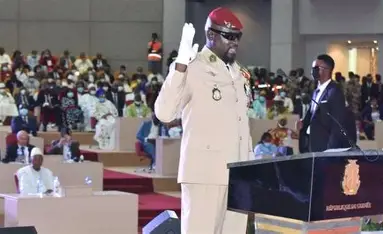
Guinea’s military leader, Colonel Mamady Doumbouya, has been declared the winner of the country’s presidential election, according to provisional results released on Tuesday, marking the formal return to civilian rule in the mineral-rich West African nation after more than three years of military governance.
Doumbouya, a former special forces commander who seized power in a September 2021 coup that ousted then-President Alpha Condé, secured an overwhelming victory in the December 28 poll, polling 86.72 per cent of the votes cast. The margin gives him an outright win and eliminates the need for a second-round runoff.
The Supreme Court is expected to review and validate the results within eight days, provided no legal challenges are filed.
His election had been widely anticipated, given the political landscape in Guinea. Key opposition figures, including former president Alpha Condé and long-time opposition leader Cellou Dalein Diallo, remain in exile, leaving Doumbouya to contest the election against a fragmented field of eight lesser-known challengers. The victory grants him a seven-year presidential mandate.
Doumbouya’s candidacy marked a significant reversal of earlier post-coup commitments. Guinea’s initial transition charter barred members of the ruling junta from contesting elections. However, that restriction was removed under a new constitution approved in a September referendum, paving the way for his participation in the presidential race.
Announcing the provisional results late Tuesday, the head of Guinea’s electoral body, Djenabou Touré, said voter turnout stood at 80.95 per cent. However, the figure has been questioned by opposition politicians, who noted low participation in parts of the capital, Conakry, and raised similar concerns following the September constitutional referendum.
Guinea’s political transition has unfolded against the backdrop of its vast natural resource wealth. The country holds the world’s largest bauxite reserves and is home to the Simandou iron ore deposit, considered the richest untapped iron ore reserve globally. The long-delayed Simandou mega mine was officially launched last month, and Doumbouya has taken credit for advancing the project and ensuring greater national benefits from its exploitation.
His administration has also pursued a strong resource nationalism agenda. Earlier this year, the government revoked the mining licence of Guinea Alumina Corporation, a subsidiary of Emirates Global Aluminium, following a dispute over refinery obligations, and transferred the assets to a state-owned company. Similar policies in neighbouring Mali, Burkina Faso and Niger have resonated with segments of the Guinean population.
Doumbouya’s relative youth has further boosted his appeal in a country where the median age is about 19. Supporters view him as a break from Guinea’s older political elite and credit him with asserting state control over strategic assets.
However, critics argue that political space has narrowed significantly under his leadership. Civil society organisations and opposition figures accuse the government of banning protests, restricting media freedom, and suppressing opposition activity.
Last week, United Nations High Commissioner for Human Rights Volker Türk said the election campaign was “severely restricted,” citing intimidation of opposition actors, alleged politically motivated enforced disappearances, and constraints on independent media.
Opposition candidate Faya Lansana Millimono also rejected the outcome, alleging “systematic fraudulent practices” and claiming that election observers were prevented from properly monitoring voting and vote counting. The Guinean government has not publicly responded to these allegations.
Doumbouya’s election places Guinea among several West and Central African countries that have experienced coups since 2020, raising ongoing debates about democratic governance, military influence in politics, and the future of civilian rule in the region.