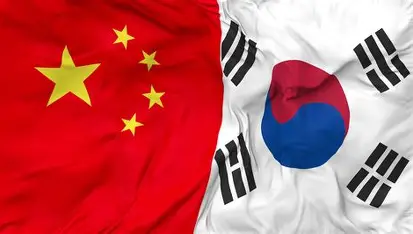
Chinese President Xi Jinping is set to host South Korean President Lee Jae Myung on a state visit beginning Sunday, a move widely seen as Beijing’s strategic effort to reinforce ties with Seoul amid escalating tensions with Japan over Taiwan.
The visit will be the second meeting between Xi and Lee in just two months an unusually short interval in diplomatic terms highlighting China’s strong interest in strengthening political, economic and people-to-people relations with South Korea. Analysts say the timing underscores Beijing’s desire to deepen cooperation with Seoul before Lee proceeds with an expected visit to Japan.
Relations between China and Japan are currently at one of their lowest points in years, following comments by Japanese Prime Minister Sanae Takaichi in November suggesting that a hypothetical Chinese military move against Taiwan could prompt a response from Tokyo. Against this backdrop, Xi’s invitation to Lee is viewed as a calculated diplomatic signal.
“China wants to emphasize South Korea’s importance more than before,” said Kang Jun-young, a professor of political economics at Hankuk University of Foreign Studies. “Beijing appears to have strategically decided that it would be preferable for President Lee to visit China before South Korea holds another summit with Japan.”
The Lee administration has made it clear that it intends to “restore” relations with Beijing, acknowledging China’s position as South Korea’s largest trading partner. This marks a shift from the strained ties seen under former president Yoon Suk Yeol, whose government pursued closer alignment with Washington and Tokyo and openly criticised China’s stance on Taiwan.
While Seoul remains committed to maintaining balanced diplomacy, analysts note that it is now leaning more toward pragmatic cooperation with China in order to avoid being drawn into regional confrontations that could destabilise Asia’s industrial and economic landscape. Lee reiterated in December that South Korea would not take sides in the diplomatic dispute between China and Japan.
Despite warming ties, China and South Korea continue to navigate sensitive and complex issues, particularly regarding the United States and North Korea. South Korea remains a key U.S. ally, hosting around 28,500 American troops to deter threats from the North.
China, meanwhile, is North Korea’s primary ally and economic lifeline. Experts believe this dynamic will feature prominently in discussions between Xi and Lee. Shin Beom-chul, a former South Korean vice defence minister and senior fellow at the Sejong Institute, said the leaders may address contentious issues such as the modernisation of the South Korea–U.S. alliance, which Beijing views as an attempt to limit China’s regional influence.
U.S. officials have also indicated plans to make American forces in South Korea more flexible, enabling them to respond to broader regional challenges, including a potential Taiwan contingency and China’s expanding military presence.
“Korea is not simply responding to threats on the peninsula,” General Xavier Brunson, commander of U.S. Forces Korea, said at a forum on December 29. “Korea sits at the crossroads of broader regional dynamics that shape the balance of power across Northeast Asia.”
Lee is also expected to urge China to play a more active role in facilitating dialogue with North Korea. However, Pyongyang has so far rejected Lee’s overtures, branding him a “hypocrite” and a “confrontational maniac.” At the same time, China and North Korea have been strengthening coordination, highlighted by Kim Jong Un’s prominent appearance alongside Xi at a major military parade in September.
Economic cooperation will be a central pillar of Lee’s visit. His office has indicated that talks will focus on critical minerals, supply chains, green industries and advanced technologies. South Korea currently sources nearly half of its rare earth mineral supply from China—materials that are essential for semiconductor manufacturing. China is also Seoul’s largest export market for chips, accounting for roughly one-third of annual exports.
In December, South Korean Industry Minister Kim Jung-kwan and Chinese Commerce Minister Wang Wentao agreed to pursue stable rare earth supply chains, reflecting mutual concerns over global disruptions.
The visit is also expected to explore cooperation in artificial intelligence and high-tech sectors. Huawei Technologies has announced plans to roll out its Ascend 950 AI chips in South Korea next year, positioning them as an alternative to Nvidia products for Korean companies. Huawei’s South Korea CEO, Balian Wang, confirmed that discussions with potential clients are ongoing, though details remain undisclosed.
Another sensitive issue on the agenda is China’s effective ban on K-pop content, which has been in place since around 2017 following South Korea’s deployment of a U.S.-led missile defence system. In a sign of potential cultural thaw, the chief executive of SM Entertainment, one of South Korea’s leading K-pop agencies, is expected to join Lee’s business delegation, according to local media.
As Xi and Lee meet at the start of the New Year, the visit signals a renewed diplomatic push by China to solidify relations with South Korea balancing geopolitics, economic interdependence and cultural exchange at a time of shifting alliances in Northeast Asia.