

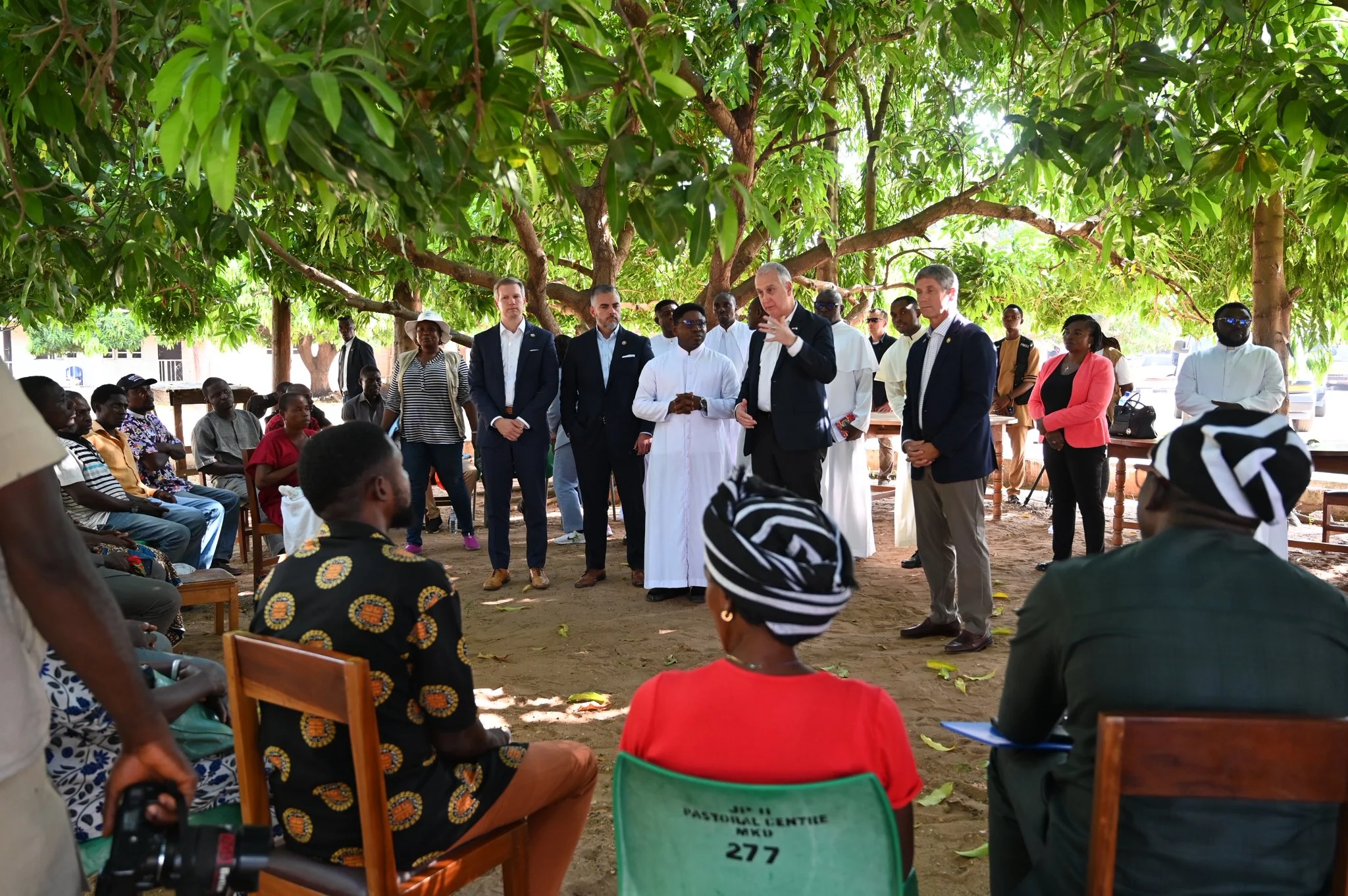
United States Congressman Riley Moore has called for urgent global attention to the worsening humanitarian crisis in Benue State after meeting with victims of violent attacks currently living in internally displaced persons’ (IDP) camps. Moore, who shared his experience in a detailed post on X, described his visit as emotionally overwhelming, revealing that many survivors recounted “unimaginable brutality” inflicted on Christian farming communities.
During his tour of multiple IDP camps, the congressman said he encountered “dozens of Christians who were driven from their homes and subjected to horrific violence.” Many narrated incidents where entire families were wiped out by armed groups, leaving only a few survivors to flee in terror.
One of the victims, a woman he met, recounted how armed attackers murdered her husband and five children before her eyes. Moore said she “barely escaped” with her unborn child. Another woman described how her family was massacred, and her baby was ripped from her womb during the violence. A male survivor also shared his trauma, saying he watched his family being hacked to death while his attackers left him with a permanently damaged arm.
According to Moore, more than 600,000 displaced Christians are currently living in camps across Benue State, a region that has endured prolonged conflict involving farming communities and heavily armed groups. He insisted the world must not ignore their suffering, stating that these citizens “deserve to live in their ancestral homeland without fear of genocidal attacks.”
Moore also held meetings with religious and traditional leaders, including Bishop Wilfred Anagbe, Bishop Isaac Dugu, and HRH James Ioruza, the Tiv traditional ruler, who briefed him on what they described as an “ongoing genocidal campaign” in the state. He said their testimonies reaffirmed the gravity of the crisis and the urgent need for international intervention.
The congressman emphasized that his visit to Nigeria was “productive,” noting that he also met with National Security Adviser Nuhu Ribadu and other senior government officials to discuss terrorism in the North-East and the killings in the Middle Belt. He said these issues remain a priority for President Donald Trump’s administration.
Moore stated that both nations evaluated new strategies that could improve security if fully implemented. He commended the Nigerian government, especially President Bola Tinubu, for the recent rescue of over 100 abducted Catholic schoolchildren, calling it a positive sign of collaborative progress.
He also referenced an already established joint Nigeria–US task force, adding that although dialogue between both countries has improved, it must “translate into concrete action.” According to him, much more remains to be done to curb insurgency, religiously targeted violence, and rising communal clashes.
The NSA confirmed the visit, describing it as part of ongoing consultations aimed at strengthening counter-terrorism cooperation, enhancing regional stability, and deepening Nigeria’s strategic security partnership with the United States.
Moore’s trip comes amid heightened diplomatic tension following the Trump administration’s redesignation of Nigeria as a Country of Particular Concern (CPC) over alleged violations of religious freedom, a move that triggered intense backlash from the Nigerian government. Authorities in Abuja have continued to dismiss claims of systemic persecution, insisting that insecurity affects all citizens regardless of faith.
On November 20, Secretary of War Pete Hegseth hosted Ribadu at the Pentagon for high-level discussions on joint security strategies. That same day, the US House Subcommittee on Africa held a public hearing evaluating the impact of the CPC redesignation.
Just last week, House Republicans raised new concerns about religious violence during a briefing mandated by President Trump, who had directed Congressman Moore and the House Appropriations Committee to investigate the alleged slaughter of Christians and report directly to the White House.
As international scrutiny intensifies, Moore insists that the testimonies of displaced families in Benue must not be ignored. He reaffirmed that the United States is committed to monitoring the crisis and supporting measures to protect vulnerable communities. But he warned that the Nigerian government must translate its commitments into tangible action, stressing that “there is still much work to be done.”