Nobel Laureate Raises Concerns Over Governance, Security Deployment, Regional Stability & Media Responsibility
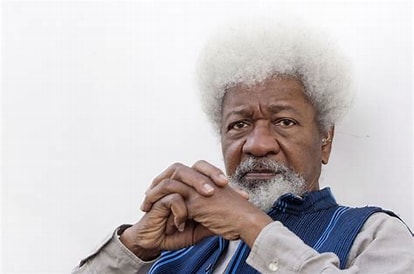
Nobel laureate Professor Wole Soyinka has raised strong concerns over what he described as an extravagant and unjustifiable deployment of state security resources around Seyi Tinubu, son of President Bola Tinubu. Speaking at the 20th Wole Soyinka Centre for Investigative Journalism (WSCIJ) Awards in Lagos, the renowned writer said the level of protection assigned to the President’s son reflects a troubling pattern of misaligned national priorities.
Soyinka recounted a recent incident in his Ikoyi hotel where he observed what he termed “an excessively large security battalion assigned to a young individual close to the Presidency.” According to him, the convoy was so overwhelming that it “could take over a small country.”
To his astonishment, he later discovered the convoy belonged to Seyi Tinubu.
Concerned about the implications, Soyinka immediately sought clarification from National Security Adviser, Nuhu Ribadu. He said he eventually reached Ribadu who was abroad with the President to express disbelief that “a child of the head of state goes around with an army for his protection.”
The playwright noted that further inquiry confirmed that the President’s son regularly moves around with the same scale of armed escort.
Soyinka described this as deeply alarming, arguing that the children of public officers must understand that proximity to power does not translate to entitlement to the machinery of the state.
“They Are Not Elected Leaders” Soyinka Emphasizes Boundaries
Soyinka stressed that members of a President’s family must not assume privileges that undermine democratic norms. He warned that using state power to cocoon individuals who hold no public office is inconsistent with a nation grappling with severe insecurity.
He also noted humorously yet pointedly that given Seyi Tinubu’s massive security presence, perhaps the President should “deploy him to confront any major insurgency outbreak.”
But the joke, he insisted, masks a serious national concern: Nigeria cannot afford to concentrate elite security assets around privileged individuals while citizens remain exposed to kidnappers, bandits, and terrorists.
A Call for Prioritisation Amid Worsening National Insecurity
According to Soyinka, Nigeria is facing multiple crises kidnappings, rural banditry, extremist attacks, and sophisticated criminal networks. Allocating a battalion to protect a single individual, he argued, sends the wrong message and reflects a dangerous misallocation of national resources.
He urged President Tinubu to reconsider the structure and scale of his son’s protective unit, emphasizing that security personnel should be deployed based on national emergencies, not familial proximity to power.
Regional Intervention: Soyinka Questions Nigeria’s Role in Benin Coup Affair
Still speaking at the awards event, Soyinka also warned against Nigeria’s increasing involvement in the recently halted coup attempt in the Republic of Benin. He framed the intervention as an avoidable military entanglement.
He criticised Nigeria’s readiness to intervene militarily, arguing that such actions often escalate rather than resolve regional instability.
“Instability anywhere in the region echoes across our own sense of security,” he said, insisting that Nigeria should invest more in diplomatic and institutional solutions.
On Lagos Demolitions: ‘Reforms Must Not Erase Humanity’
Soyinka also addressed the ongoing demolition of properties in Lagos, highlighting the trauma faced by displaced residents.
He noted receiving disturbing photos and testimonies from families affected by the exercise and cautioned that even when demolitions are legally justified, government must uphold humane standards.
“Let us not strip away the humanity of the people affected,” he said, calling for evacuation and urban reform processes that prioritise dignity, communication, and humane timing.
Media and Misinformation: Soyinka Warns Journalists
Turning to the media, Soyinka praised the Nigerian press for its resilience but urged newsrooms to adopt stronger editorial discipline amid rising misinformation.
He warned that the next major global or national conflict might be triggered by reckless or malicious content on social media platforms.
He described credible journalism as one of Nigeria’s most vital defences against disorder, urging media professionals to recommit to truth, verification, and ethical reporting.