
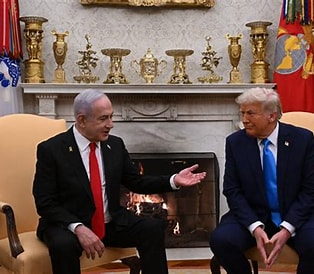
United States President Donald Trump has issued a stern warning to Hamas and Iran, threatening renewed military action if Hamas fails to disarm in Gaza and if Tehran attempts to rebuild its nuclear or ballistic missile capabilities. The warning followed high-level talks between Trump and Israeli Prime Minister Benjamin Netanyahu on Monday, where both leaders projected a united front on regional security and Middle East diplomacy.
Speaking at a joint news conference with Netanyahu at his Mar-a-Lago resort in Florida, Trump said Hamas would face severe consequences if it does not comply with disarmament commitments under the fragile Gaza ceasefire agreement. He also cautioned Iran against reviving nuclear or missile programmes that were targeted during earlier US and Israeli strikes.
“If they don’t disarm as they agreed to do, then there will be hell to pay for them,” Trump told reporters. “They have to disarm in a fairly short period of time.”
Trump downplayed speculation about tensions between Washington and Tel Aviv over the next phase of the Gaza ceasefire, insisting that Israel had met its obligations and that responsibility now rested squarely on Hamas. He said he had “very little difference” with Netanyahu and expressed confidence in Israel’s approach to the truce process.
Hamas, however, appeared unmoved by the threat. Earlier on Monday, the group’s armed wing reiterated that it would not surrender its weapons, maintaining that disarmament was impossible as long as Israeli occupation continued in Palestinian territories.
At the same time, Trump turned his focus to Iran, warning that the United States would not hesitate to strike again if Tehran attempted to rebuild facilities damaged during earlier attacks. He accused Iran of potentially seeking new nuclear sites and restoring its missile arsenal following the 12-day conflict with Israel earlier this year.
“I hope they’re not trying to build up again because if they are, we’re going to have no choice but very quickly to eradicate that buildup,” Trump said. He added that any future US response “may be more powerful than the last time.”
Iran swiftly responded to the remarks. Ali Shamkhani, a senior political adviser to Iran’s Supreme Leader, warned that any aggression against Iran would be met with an immediate and forceful response. In a post on X, he insisted that Iran’s missile and defence capabilities could not be restricted or dictated by external powers.
“Iran’s missile capability and defence are not containable or permission-based,” Shamkhani wrote. “Any aggression will face an immediate harsh response beyond its planners’ imagination.”
Despite the sharp rhetoric, Trump said he believed Iran was still interested in reaching a deal with Washington over its nuclear and missile programmes. Tehran, for its part, has repeatedly denied seeking nuclear weapons.
Netanyahu described his meeting with Trump as “very productive” and announced that Israel would award the US president its highest civilian honour, marking the first time the distinction has been given to a non-Israeli citizen. The Israeli leader also appeared to align closely with Trump’s position on Iran, reinforcing Israel’s long-standing concerns over Tehran’s regional ambitions.
This marked the fifth meeting between Trump and Netanyahu in the United States since Trump returned to power earlier this year. During the talks, Netanyahu reportedly emphasized Israeli intelligence assessments suggesting that Iran is working to restore parts of its missile arsenal damaged during the June conflict.
Trump, who has styled himself as a “president of peace,” said he was eager to move to the next phase of the Gaza truce. That stage is expected to include the formation of a Palestinian technocratic government and the deployment of an international stabilization force to help maintain security.
While some White House officials have privately expressed concerns that Israel may be delaying progress, Trump dismissed such claims, saying he was “not concerned about anything that Israel’s doing.”
Beyond Gaza and Iran, the discussions also touched on other regional flashpoints, including Syria and Hezbollah in Lebanon. Trump said he hoped Netanyahu could eventually establish a working relationship with Syria’s new president, a former Islamist rebel commander who ousted long-time leader Bashar al-Assad a year ago, despite recent Israeli airstrikes along the border.
Netanyahu’s visit capped several days of intense diplomatic engagement for Trump, who hosted Ukrainian President Volodymyr Zelensky a day earlier for talks on ending Russia’s invasion of Ukraine.
The Gaza ceasefire, reached in October, remains one of the most significant foreign policy achievements of Trump’s first year back in office. US officials and regional mediators have continued to push for momentum, with reports suggesting that Washington hopes to announce an interim governance arrangement and international security presence for Gaza as early as January.
Trump offered few specifics on the timeline but said he hoped reconstruction could begin soon in the Palestinian territory, which has been devastated by months of fighting following Hamas’s October 7, 2023 attacks on Israel.
However, the issue of Hamas’s disarmament remains a major stumbling block. In a video message released on Monday, the Ezzedine al-Qassam Brigades reaffirmed their refusal to lay down arms.
“Our people are defending themselves and will not give up their weapons as long as the occupation remains,” the group said.
As diplomatic efforts continue, Trump’s remarks underscored the high stakes surrounding the Gaza ceasefire and the broader regional balance, with the United States signalling readiness to apply both pressure and force to shape outcomes in the Middle East.