


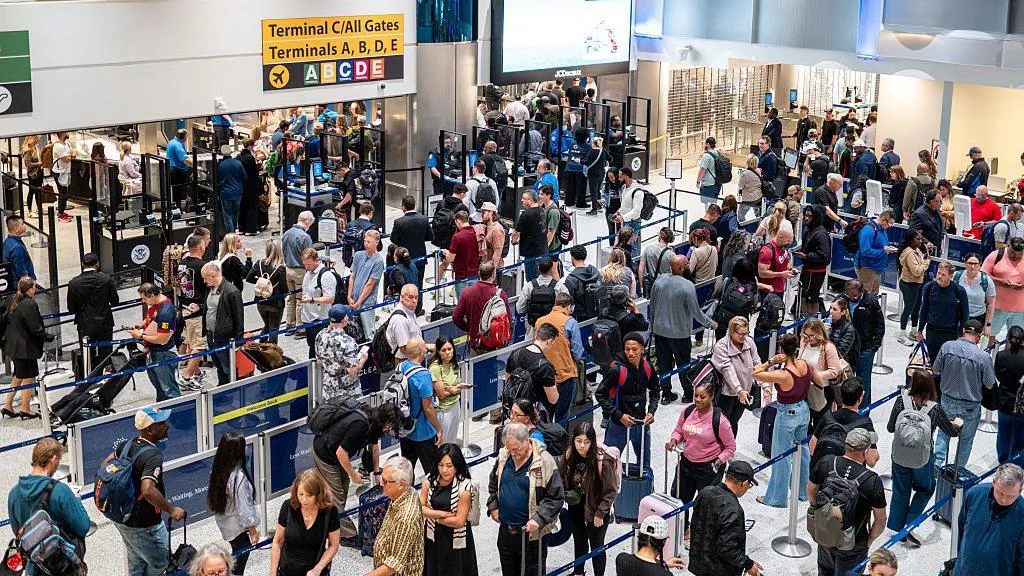
The ongoing federal government shutdown in the United States has entered its 39th day, bringing with it far-reaching economic consequences most notably in the aviation sector. On Saturday, more than 1,400 flights across the country were cancelled, while nearly 6,000 others faced delays, signaling a deepening crisis that has started to cripple one of America’s most vital industries.
According to data from FlightAware, one of the world’s top flight-tracking platforms, the cancellations affected flights to, from, and within the United States, as the Federal Aviation Administration (FAA) continues enforcing its emergency directive to reduce air traffic capacity by up to 10%. The measure, officials say, is a necessary safety precaution amid growing fatigue among air traffic controllers, who have been working without pay since the shutdown began on October 1st.
The FAA, in an earlier statement, explained that the cuts would be implemented in phases beginning with 4% reductions on Friday, increasing to 6% by November 11, 8% by November 13, and peaking at 10% by November 14. These reductions are already being felt across the nation, creating ripple effects in the economy and heightening frustration among travelers and airlines alike.
Major airports, including Newark Liberty International (New Jersey), Charlotte/Douglas International (North Carolina), and Chicago O’Hare International (Illinois), have been hardest hit, with hundreds of flights either delayed or cancelled. By Saturday afternoon, the FAA reported that average arrival delays into Newark were over four hours, while departures were running behind by up to 90 minutes.
Other major airports John F. Kennedy International (New York), Hartsfield-Jackson Atlanta International (Georgia), and LaGuardia (New York) also recorded extensive disruptions, with delays stretching between one and three hours.
In response, American Airlines issued a statement urging “leaders in Washington, D.C., to reach an immediate resolution to end the shutdown,” warning that the aviation chaos is not just an inconvenience but a growing economic threat.
The timing could not be worse. With the Thanksgiving holiday approaching on November 27, the United States is entering one of its busiest travel periods of the year, typically seeing tens of millions of passengers take to the skies. Aviation analysts fear that if the shutdown persists into late November, the industry could experience a catastrophic operational breakdown, stranding millions and costing airlines hundreds of millions in lost revenue.
It’s not only commercial aviation that’s affected. FAA Secretary Duffy confirmed via X (formerly Twitter) that private jet operations are being curtailed as well.
“We’ve reduced their volume at high-traffic airports instead having private jets utilize smaller airports or airfields so busy controllers can focus on commercial aviation,” Duffy explained. “That’s only fair.”
This move, while aimed at preserving safety, has stirred discontent among private operators and business executives who rely on chartered flights for mobility. Industry groups argue that the restrictions will further slow business activities and increase travel costs, particularly in sectors like finance, technology, and logistics.
The effects of the government shutdown extend far beyond delayed flights and frustrated travelers. Economists warn that the shutdown’s impact on the aviation sector is a mirror of broader economic strain, potentially shaving billions off the U.S. GDP if it continues.
Roughly 1.4 million federal employees have been affected either working without pay or placed on forced leave creating financial stress across households and local economies. Among them are air traffic controllers, TSA agents, and other critical aviation workers who have continued to show up despite not receiving salaries for weeks.
The Transportation Security Administration (TSA), which employs over 64,000 agents, is also struggling. Many staff members are calling out sick or resigning altogether, leading to longer airport queues and increasing flight processing delays.
This situation echoes the 2018–2019 government shutdown during the administration of President Donald Trump, which lasted 35 days then the longest in U.S. history and cost the U.S. economy an estimated $11 billion, according to the Congressional Budget Office (CBO). Analysts fear that if the current standoff continues, the economic toll could surpass that figure, given the increased cost of inflation and the scale of today’s aviation infrastructure.
The shutdown, now the longest in U.S. history, stems from a deadlock between Republicans and Democrats over the passage of a new funding resolution to reopen the government. Both sides remain entrenched, despite growing public pressure and bipartisan talks that have continued over the weekend.
The FAA’s reduction of air travel capacity was one of several emergency measures announced this week to prevent operational collapse in the nation’s aviation system. Yet, as the shutdown drags on, public confidence is waning, and frustration is mounting among both travelers and federal workers.
Senators from both parties met in Washington on Saturday for negotiations, but no significant progress was reported as of press time. Meanwhile, industries dependent on aviation — from tourism and hospitality to logistics and manufacturing are beginning to feel the shockwaves.
Economists caution that even if the shutdown ends soon, the economic recovery could take weeks, as flight schedules, worker morale, and consumer confidence all take time to stabilize.
With Thanksgiving around the corner, the shutdown’s timing couldn’t be more disruptive. Travelers are anxiously monitoring flight schedules, airlines are juggling logistical nightmares, and federal workers are stretched to their limits all while the political stalemate in Washington shows few signs of easing.
For now, the FAA insists that safety remains its top priority, even as it struggles to manage operations under severe manpower shortages. But unless a resolution is reached soon, experts warn that the skies over America may remain as turbulent as the nation’s politics itself.