
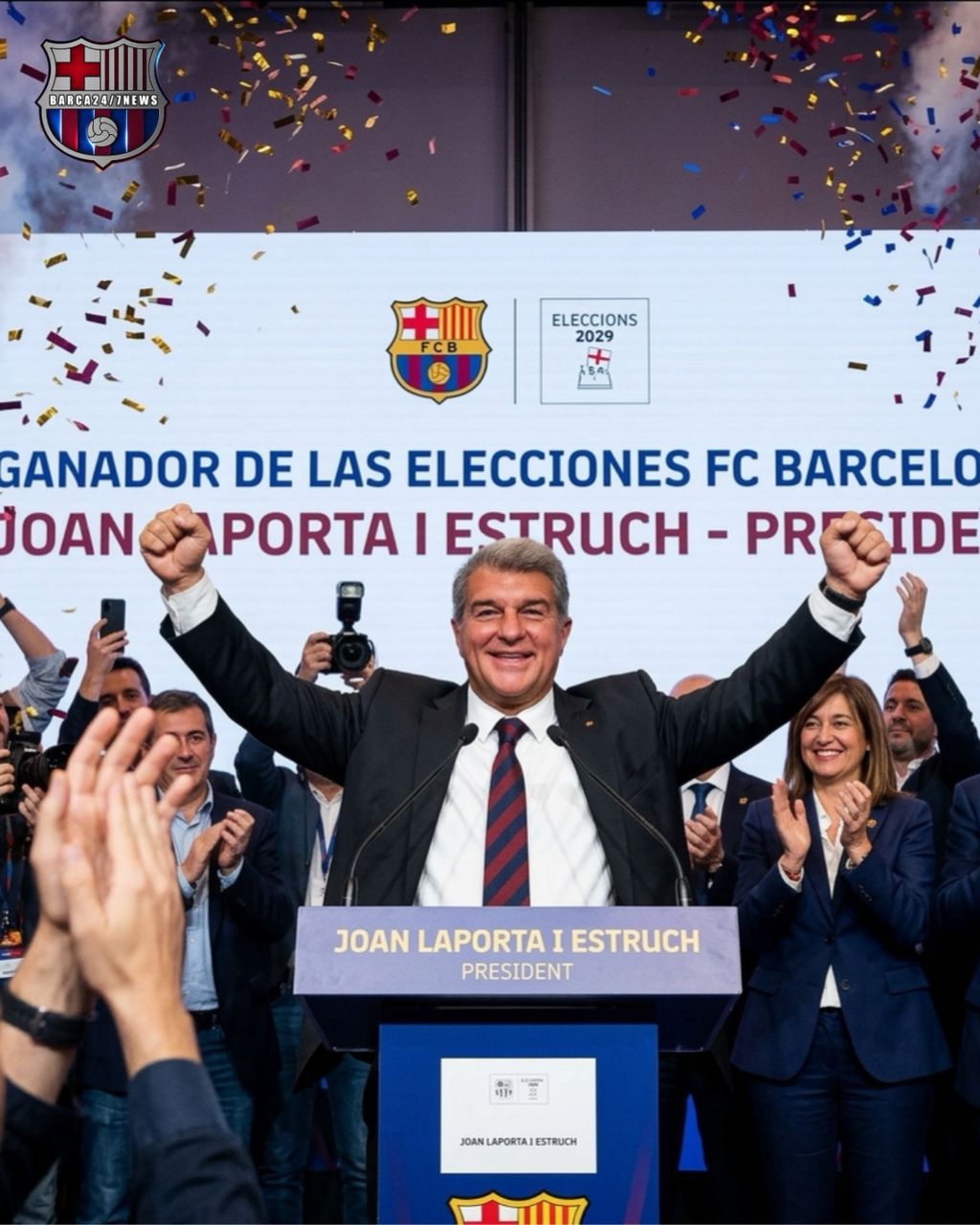
Joan Laporta has been re-elected as president of FC Barcelona after securing a convincing victory in the club’s 2026 presidential election, extending his leadership of one of the world’s biggest football institutions.
The election, held on March 15, 2026, saw thousands of club members cast their votes to determine who would lead the Catalan giants for the next five years. Laporta defeated his main challenger, Victor Font, by a significant margin, reaffirming the confidence of club members in his administration. (Cadena SER)
Laporta’s victory means he will continue as president of the club until 2031, overseeing Barcelona’s sporting and financial direction during a crucial rebuilding period. (Cadena SER)
According to preliminary data from the election process, Laporta secured roughly around 69 percent of the vote, while his closest rival Victor Font received about 28 percent, with a small percentage of blank or invalid votes recorded. (Cadena SER)
The election attracted over 48,000 voters, representing about 42 percent turnout among eligible members, demonstrating strong participation in the democratic process that governs the club. (Cadena SER)
Only registered club members known as socios are allowed to vote in Barcelona presidential elections, making the process one of the most unique governance systems in world football.
The 2026 election was largely framed as a choice between continuity and change.
Laporta campaigned on his record during the previous term, highlighting the club’s financial recovery efforts, sporting progress, and ongoing renovation of the historic Camp Nou stadium.
His campaign emphasised: Financial restructuring after years of debt, continued investment in youth development, completion of the Espai Barça stadium redevelopment project, sustaining Barcelona’s competitiveness in European football
Meanwhile, Victor Font campaigned on promises of structural reforms and new leadership strategies aimed at modernising the club’s governance.
Despite Font’s efforts, Laporta maintained strong support among club members, many of whom credited him with stabilising Barcelona after a turbulent period in the club’s history.
Laporta is widely regarded as one of the most influential presidents in Barcelona’s history.
He first served as club president between 2003 and 2010, a period that saw Barcelona win multiple major trophies, including the UEFA Champions League and several **La Liga titles.
During that era, the club enjoyed enormous success with legendary players such as Lionel Messi, while the team under coach Pep Guardiola achieved historic dominance in European football.
Laporta returned to power in 2021, promising to restore stability after financial challenges and administrative controversies that followed the departure of previous leadership.
Despite his electoral victory, Laporta faces several challenges in the coming years.
These include managing the club’s finances, strengthening the squad to compete for major titles, and completing the ambitious redevelopment of the Camp Nou stadium.
Barcelona is also seeking to maintain strong performances domestically and internationally, particularly in the UEFA Champions League.
With a blend of experienced players and emerging young stars, the club’s sporting project is expected to remain a major focus of Laporta’s new administration.
The announcement of Laporta’s victory sparked celebrations among many Barcelona supporters, who see his re-election as a sign of stability and continuity for the club.
Several players, club officials, and supporters participated in the election process, reinforcing the club’s unique member-driven governance model.
For many fans, the result reflects confidence that Laporta can guide Barcelona through the next phase of its evolution both on and off the pitch.